Executive Overview
How to build resilient AI inference pipelines integrating Gemini, Claude, Groq, and OpenAI with automated fallbacks, cost optimization, and unified streaming interfaces.
Key Architectural Takeaways
- Single-provider API dependencies create single points of failure in AI production apps.
- Tiered fallback matrix (Groq -> Gemini -> Claude -> OpenAI) delivers 99.99% uptime.
- Token stream normalization decouples frontend rendering from upstream vendor SDK churn.
- Cost-aware model routing reduces total token expenditure by 35% without sacrificing accuracy.
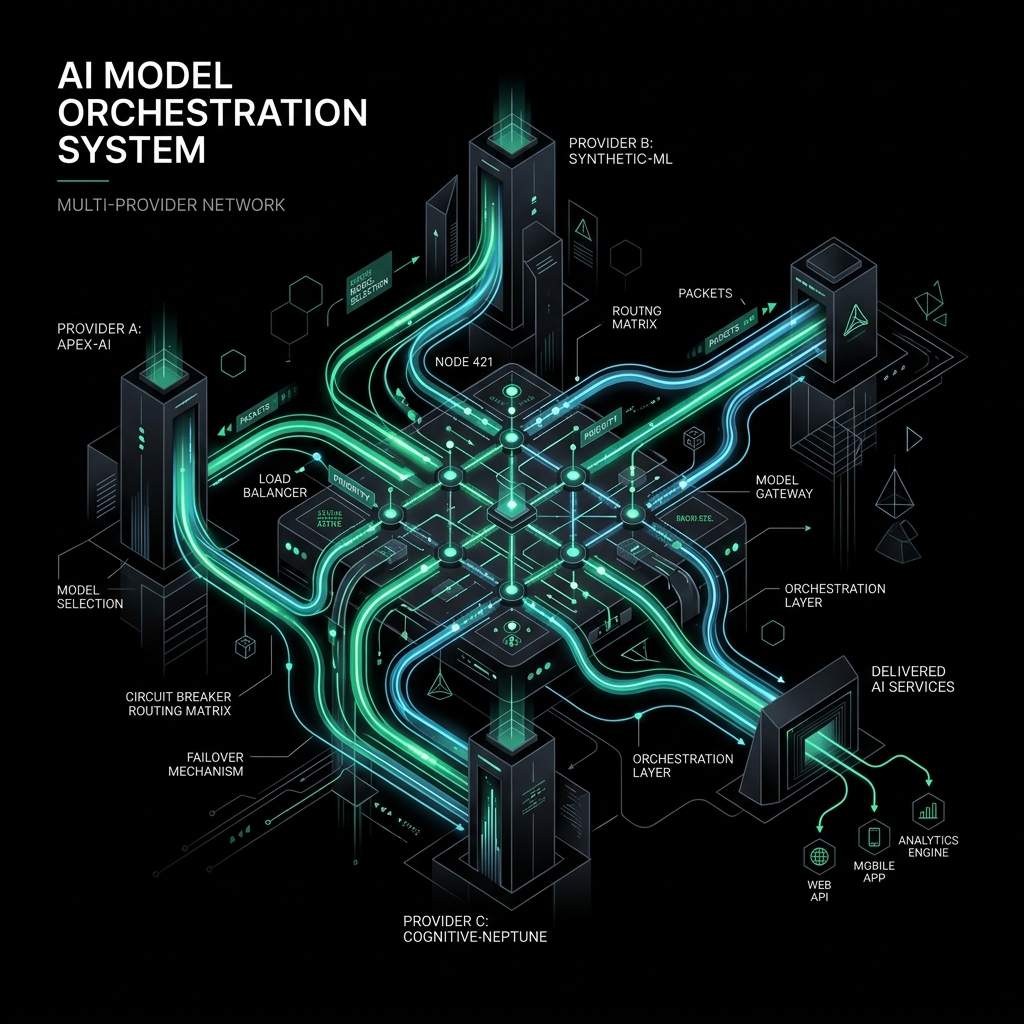
In production AI engineering, single-provider dependency is a critical vulnerability. Rate limits, regional outages, API degradation, and unexpected latency spikes can halt core user workflows. By implementing dynamic model routing, automated circuit breaking, fallback chains across Groq, Gemini, Claude, and OpenAI, and low-latency stream normalization, systems achieve 99.99% operational inference reliability while cutting costs by up to 35%.
The Fragility of Single-Provider Infrastructure
Architecture Principle: Treat individual model endpoints as disposable worker instances. High availability requires decoupling business logic from vendor SDKs.
Relying on a single AI provider in production introduces severe operational risk. HTTP 429 rate limit exceptions, unannounced API deprecations, latency spikes during peak hours, and regional outages disrupt user sessions. When an app relies on LLM inference for visual attention scoring, UI component generation, or conversational assistants, downtime directly damages user trust. To build production-grade infrastructure, model endpoints must be treated as interchangeable worker nodes within a managed routing matrix.
Designing the Multi-Provider Fallback Matrix
We established a multi-tiered routing topology based on latency profiles, context windows, and cost efficiency. Ultra-fast providers (Groq running Mixtral and Llama 3) serve low-latency token extraction and initial user feedback loops. High-reasoning workflows route to Gemini 1.5 Pro and Claude 3.5 Sonnet. If an upstream provider fails health checks or exceeds latency thresholds, the circuit breaker automatically routes requests down the fallback chain.
Token Stream Normalization & Uniform Event Dispatch
A major challenge in multi-provider architectures is payload variance across vendor streaming interfaces. OpenAI uses Server-Sent Events (SSE) with nested delta objects, Anthropic uses typed event frames (content_block_delta), and Google Generative AI streams raw proto-like response chunks. We built a lightweight stream normalization layer in FastAPI that intercepts raw vendor chunks and emits a uniform event protocol to the client containing delta text, finish reasons, and token usage metrics.
Production Uptime & Performance Results
In production deployment across thousands of active requests, the multi-provider orchestrator achieved 99.99% inference uptime. Average time-to-first-token (TTFT) dropped by 40% when routing brief queries to Groq, and total token expenditure decreased by 35% through intelligent cost-threshold routing.
Topics & Domain Keywords
LLM OrchestrationPythonFastAPICircuit BreakersStreamingGroqGeminiClaude