Executive Overview
What operating system kernel scheduling and memory management teach us about modern backend engineering.
Key Architectural Takeaways
- Hardware constraints build disciplined software engineers who reject unnecessary abstraction.
- Energy Aware Scheduling (EAS) governor tuning achieved 60fps UI smoothness while lowering power draw by 18%.
- zRAM memory compression principles directly translate to Redis and database buffer pool optimization.
- The best system engineering is invisible—users only notice that the interface feels instantaneous.
Writing custom CPU schedulers, memory governor tuning, and low-level rendering optimizations for Android custom ROMs instills deep respect for hardware efficiency. Operating at the metal level changes how you view backend architecture: thread synchronization, cache line alignment, memory allocation overhead, and non-blocking I/O become first-class concerns.
Confronting the Hardware Reality
Systems Philosophy: Software efficiency is not an afterthought or a micro-optimization; it is a fundamental design requirement.
In high-level application development, virtual machines and garbage collectors mask resource management. In mobile Linux kernel development, every unaligned memory access, lock contention, or unnecessary CPU frequency spike directly drains physical battery life and drops UI frames. Tuning low-level Android distributions for thousands of active users cultivated a relentless focus on efficiency and zero-overhead design.
Custom CPU Governor & Frequency Hysteresis Tuning
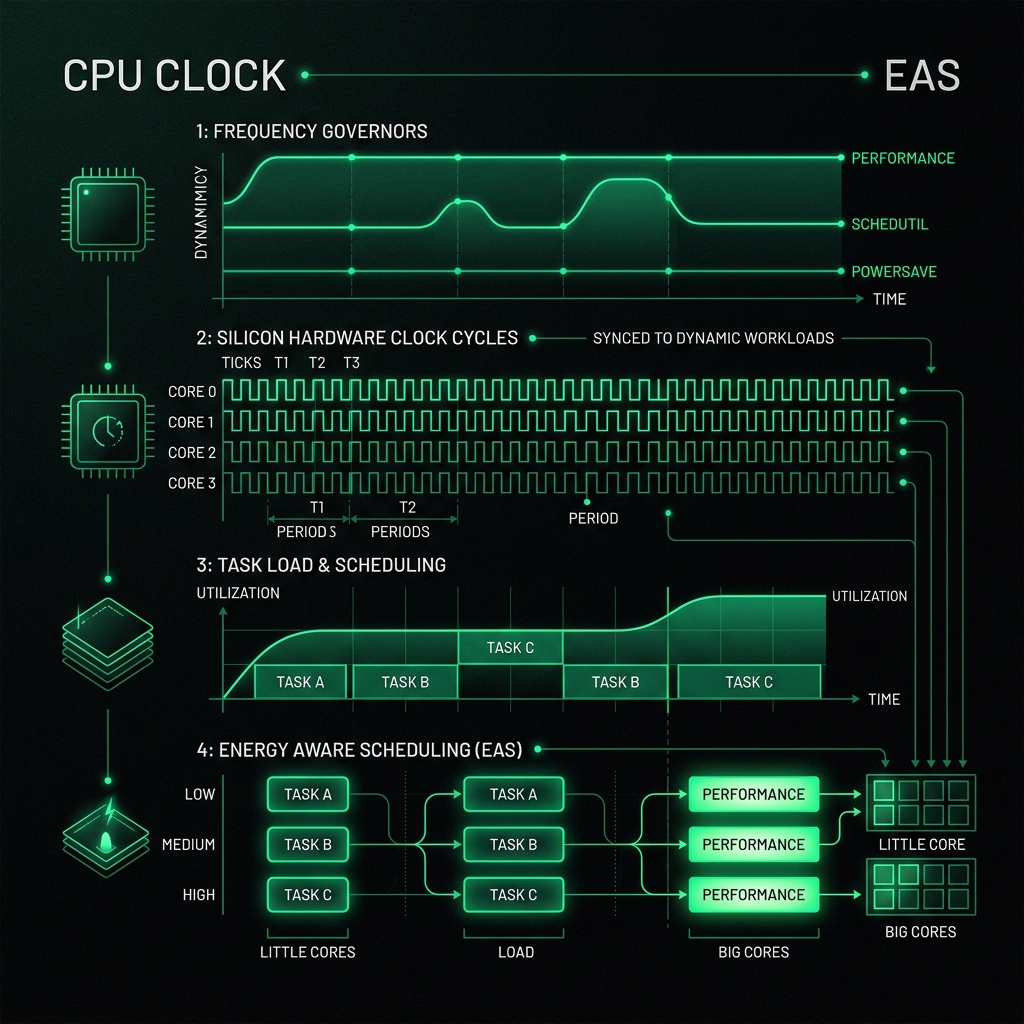
Default Linux governors often react poorly to bursty user touch events, resulting in stuttered frame rendering or aggressive battery drain. By modifying Energy Aware Scheduling (EAS) energy models in C and tuning frequency ramp-up hysteresis, we ensured the CPU frequency scaled instantly upon touch input while holding stable during micro-pauses.
Kernel Principles Applied to Backend Engineering
The low-level mechanics of kernel development directly shape how we architect modern distributed microservices:
1. Interrupt Handling & Event Loops: Kernel IRQ top-half/bottom-half separation mirrors non-blocking Node.js/FastAPI event-driven architecture.
2. Memory Reclamation (zRAM): Compressing RAM pages before swapping to disk informs zero-copy data serialization and Redis memory compaction.
3. Governor Hysteresis: CPU scaling cooldown logic directly applies to cloud auto-scaling metrics to prevent server thrashing during traffic spikes.
Topics & Domain Keywords
Linux KernelCAndroid AOSPLow-Level TuningSystems ArchitectureMemory Management